
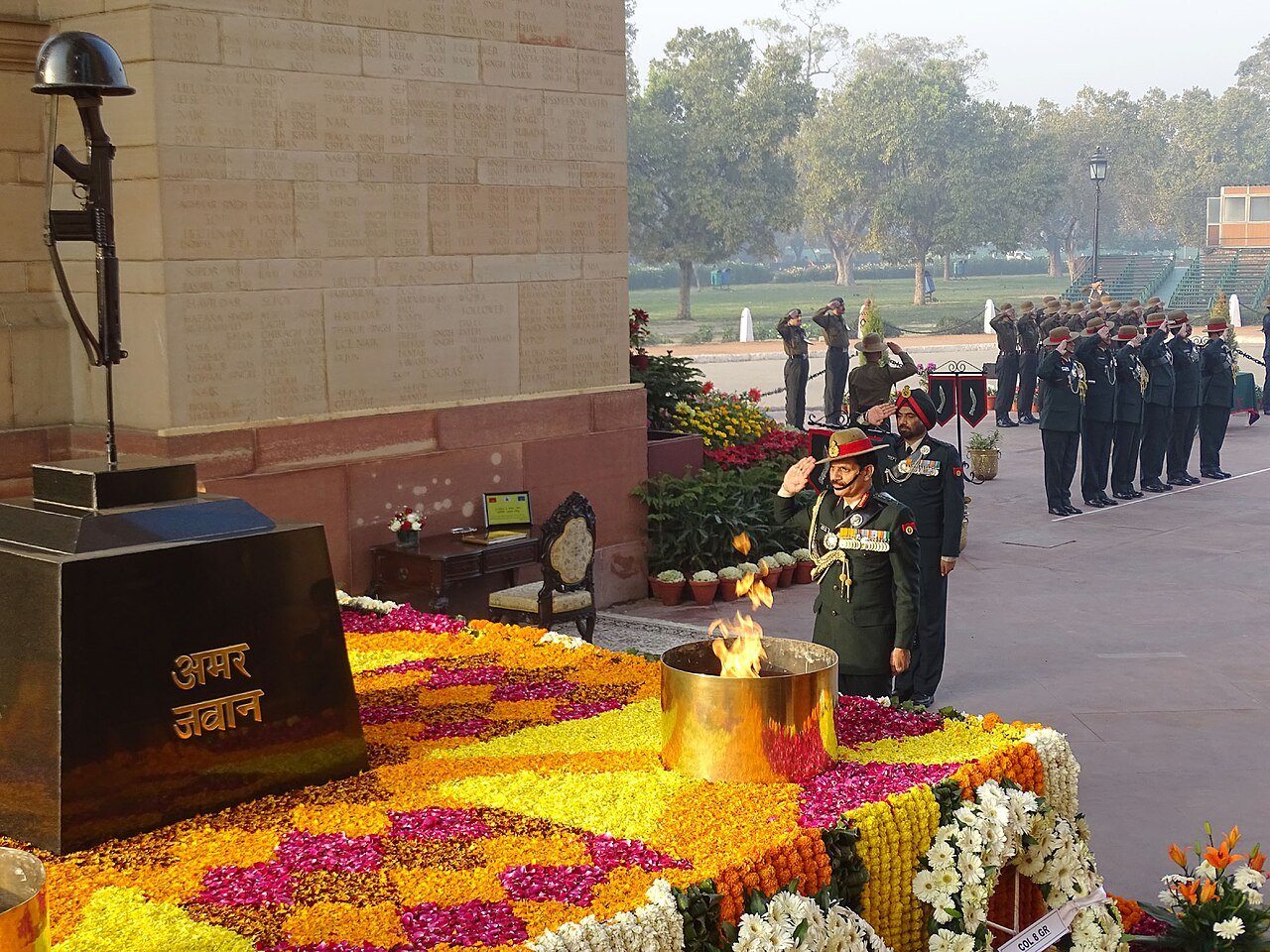
Army chief General Dalbir Singh paying homage at Amar Jawan Jyoti during the Gorkha Rifles bicentenary. Image: Ministry of Defence, GODL-India, via Wikimedia Commons.
Foreign Secretary Vikram Misri visits Kathmandu on November 4 and 5, the first such trip since Prime Minister Balendra Shah took charge in March after Nepal’s Gen-Z uprising. The visit is new. The structures underneath the relationship are old, and three of them explain most of how India and Nepal actually deal with each other.
The 1950 treaty
The Treaty of Peace and Friendship between India and Nepal was signed in Kathmandu on July 31, 1950. Article 1 promises “everlasting peace and friendship” and mutual respect for sovereignty and territorial integrity. Article 7 is the operational one: each country grants the other’s citizens the same privileges in residence, ownership of property, participation in trade and commerce, and movement. That reciprocal national treatment is the legal foundation of what both sides call the open border, which their citizens cross for work, family and trade without the formalities seen at most international boundaries.
The Gorkha link
The defence relationship is older than the republic on either side. Around 32,000 Gorkha soldiers from Nepal were serving in the Indian Army as of the MEA’s most recent bilateral brief. The two armies hold the unusual tradition of conferring the honorary rank of General on each other’s army chief, and India runs pension-paying offices in Kathmandu, Dharan and Pokhara for ex-Gurkha soldiers. It is also the live friction point: recruitment of Gurkha soldiers has been suspended since the Agnipath scheme began, and ex-servicemen protested in Kathmandu on Monday demanding it resume.
The development partnership
India is Nepal’s largest development partner, with grant projects running from the East West Highway to the BP Koirala Institute of Health Sciences in Dharan. Nepal shares a border with five Indian states: Sikkim, West Bengal, Bihar, Uttar Pradesh and Uttarakhand. New Delhi describes Nepal as a priority partner under its Neighbourhood First policy.
What to watch this week
Three items are on the table for Mr. Misri: a possible India visit by Mr. Shah, which would be his first bilateral trip abroad; the appointment of Nischal Nath Pandey as Nepal’s new ambassador in New Delhi; and assistance after the Bhote Koshi flash floods. Each sits comfortably inside the old framework, which is the point.