
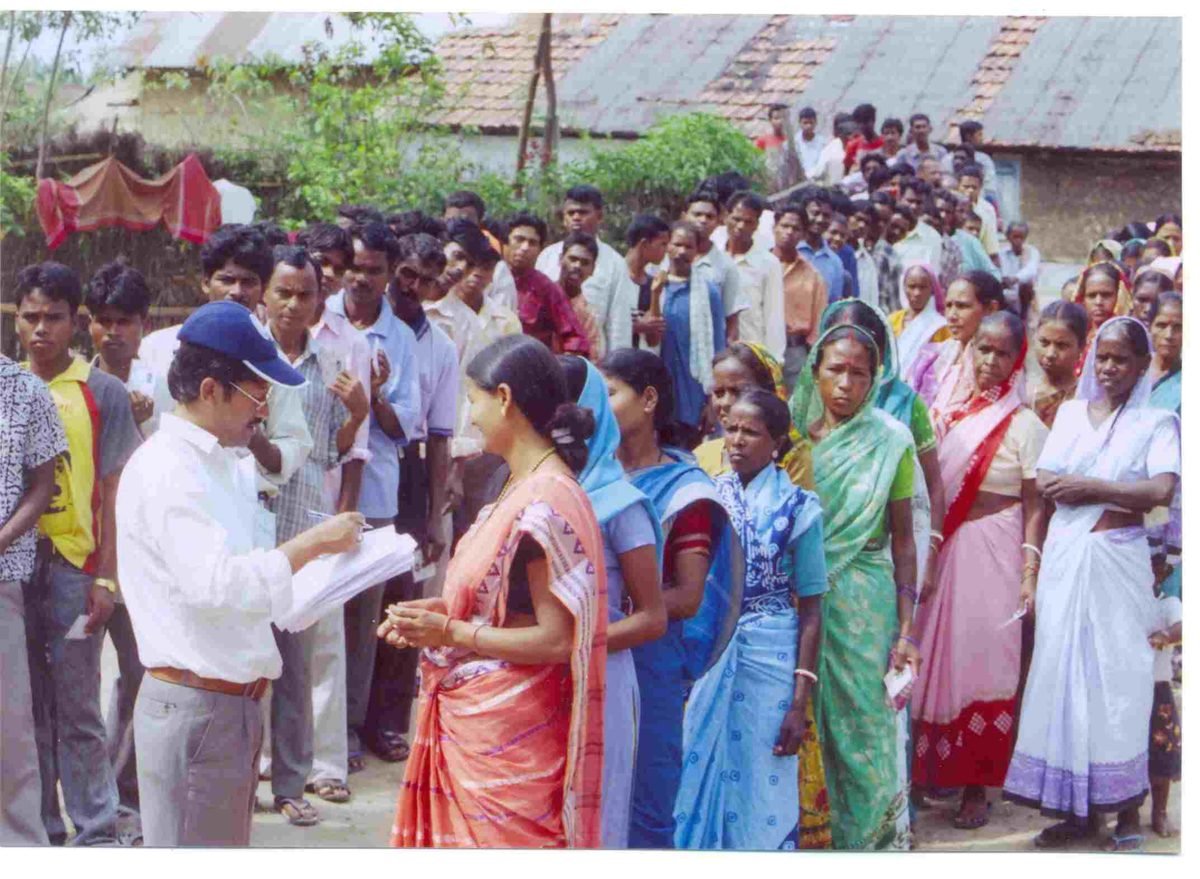
File photo: a polling officer checks voters’ EPIC cards at a queue in Phasidewa, West Bengal, May 8, 2006. Election Commission of India. Wikimedia Commons. Source URL. GODL-India. Resized.
The Election Commission told the Supreme Court on Friday that it found “false” Form 7 applications seeking voter deletions during the Uttar Pradesh Special Intensive Revision, but accepted none of them. The petitioner in the case, Barabanki MP Tanuj Punia, has sought penal action under Section 31 of the Representation of the People Act, 1950. Here is what that provision says.
The exact text
Section 31 of the Representation of the People Act, 1950, “Making false declarations”, states: “If any person makes in connection with — (a) the preparation, revision or correction of an electoral roll, or (b) the inclusion or exclusion of any entry in or from an electoral roll, a statement or declaration in writing which is false and which he either knows or believes to be false or does not believe to be true, he shall be punishable with imprisonment for a term which may extend to one year, or with fine, or with both.”
What it covers
The provision applies to written statements or declarations made in connection with an electoral roll’s preparation, revision or correction, or with the inclusion or exclusion of any entry — which covers declarations made with Form 7 applications for deletion or objection. It penalises statements that are false and that the maker knows or believes to be false, or does not believe to be true.
The penalty
The maximum punishment is imprisonment for up to one year, or a fine, or both. Separately, the ECI’s September affidavit said it had “categorically directed” booth-level officers not to digitise any form without proper checking and not to accept Form 7s in bulk, after bulk-submission attempts in Uttar Pradesh.
Where the case stands
The Supreme Court on Friday asked the ECI to “look into these issues, take necessary action and file a compliance report” — a direction during an ongoing hearing, not a final finding. The allegations in Mr. Punia’s petition, including forged signatures and forms filed in the names of persons who later denied filing them, remain allegations under examination.
Sources: RP Act, 1950 (PDF) · The Hindu