
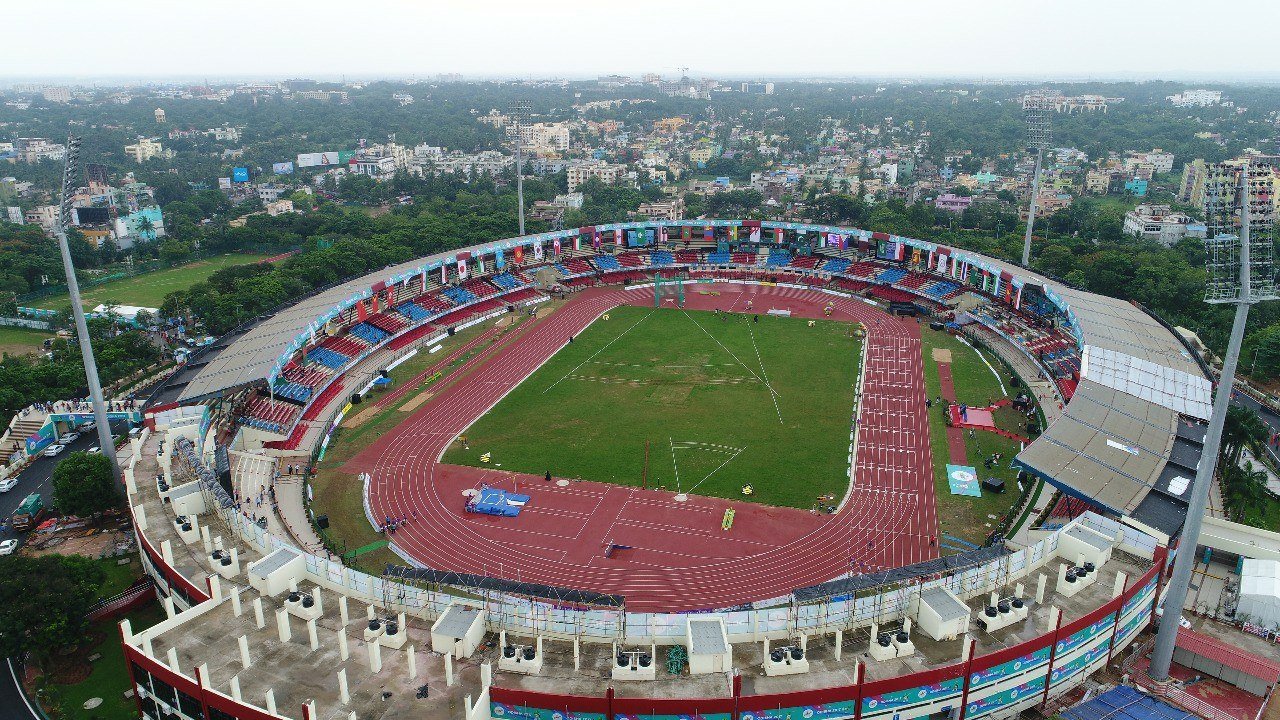
File photo: an aerial view of the Kalinga Stadium in Bhubaneswar, one of the homes of Indian hockey. Government of Odisha. Aerial view of Kalinga Stadium.jpg. Wikimedia Commons. Source URL. Published under CC BY 4.0. Cropped and resized.
For three quarters in Mohali on Thursday, India looked nothing like champions. Then came four goals, a 4-1 win over Japan, and a record sixth Asian Champions Trophy title – the third in a row, and the end of an unbeaten campaign, Sportstar reported.
How the final turned
Japan flipped the script from the start, attacking instead of sitting back, and took the lead in the third minute through Kazumasa Matsumoto, left unmarked outside the circle and ruthless with his finish past Suraj Karkera. What followed was a lesson in defensive discipline: India dominated possession and territory – 22 circle entries and 12 shots at goal to Japan’s seven and two – yet won its first penalty corner only in the 33rd minute and kept wasting openings.
The equaliser came in the 42nd minute, when a penalty-corner variation was kept alive desperately and Shilanand Lakra whacked it home. Japan’s resistance cracked, and Dilpreet Singh, Jugraj Singh and Sukhjeet Singh scored to close out the final 4-1. Malaysia beat Korea 5-2 earlier to take bronze.
Why the sixth title matters
The Asian Champions Trophy gathers Asia’s best hockey nations every year or two, and India has now won it six times – more than any other country – including the last three editions in succession. Retaining a title as host, in a packed stadium on a weekday, also says something about where hockey sits in Indian sport right now: a team expected to win, playing in front of crowds that demand it.
The pattern of a champion
Thursday’s final showed both sides of this team. For forty minutes it was erratic and wasteful, pressure visible in every missed trap. But the midfield trio of Hardik Singh, Vivek Sagar Prasad and Nilakanta Sharma kept winning turnovers until the breakthrough came – and once it did, the fluid attacking hockey India is known for took over. Winning ugly, Sportstar’s report suggests, is part of what makes opponents wary of this side.
What next
An unbeaten continental campaign is the ideal launchpad for a bigger cycle: India’s hockey calendar now turns to the Pro League and, beyond it, the road to the 2028 Olympics, where this core will be expected to convert continental dominance into a global medal.