
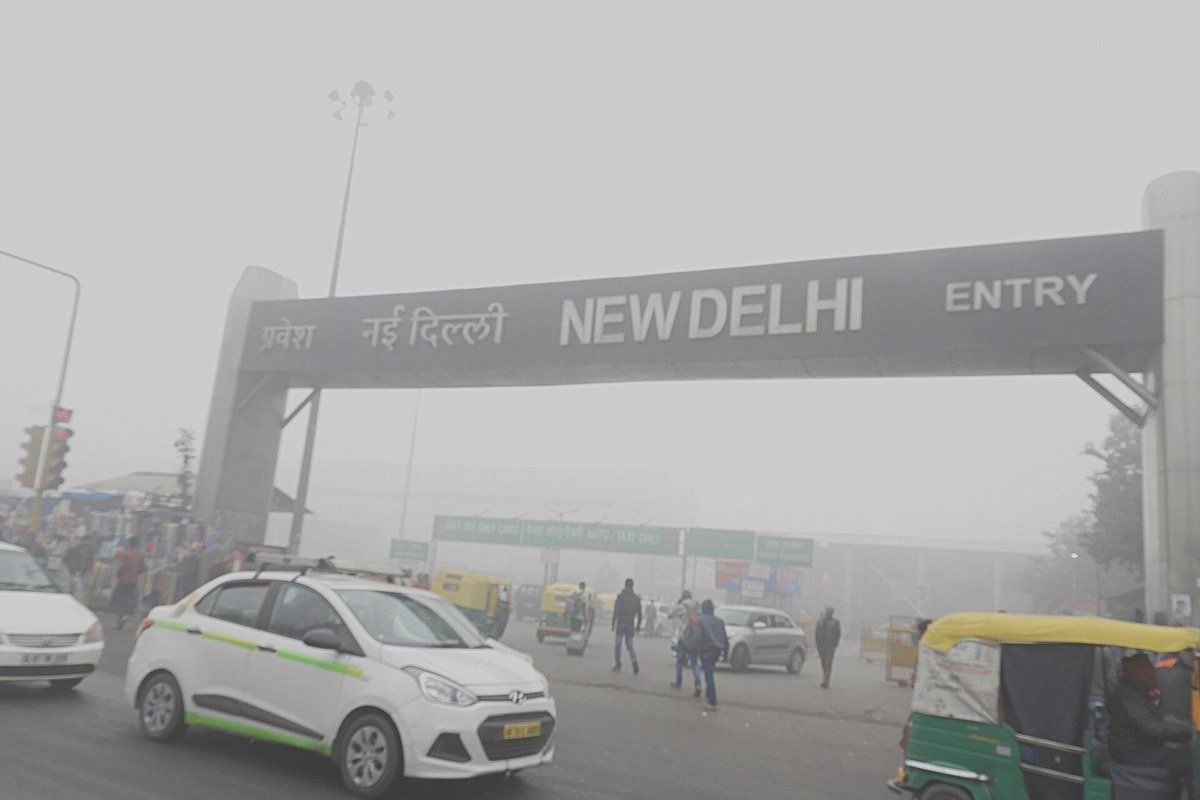
File photo: low visibility due to smog at the New Delhi railway station entrance. Sumita Roy Dutta. Wikimedia Commons. Source URL. Published under CC BY-SA 4.0. Cropped and resized.
The Supreme Court has flagged vehicular emissions as the consistent danger sustaining Delhi’s toxic air, going well beyond the Deepavali firecracker question, The Hindu reported. Here is what the court said and what it has asked authorities to do.
What the court said
A Bench headed by Chief Justice of India Surya Kant said the people, and not the judiciary, must strike a blow against air pollution in the national capital. On November 6, the court detected a sharp increase in issues attributable to vehicular emissions. It said the thick smog, which later raised the city’s Air Quality Index almost to the “severe” category following Deepavali, had nowhere to go in the landlocked capital, and that substantial commercial and non-commercial traffic entering Delhi would only compound the problem.
“It must be borne in mind that Delhi and the National Capital Region (NCR), by virtue of their geographical and economic interconnectedness, bear the cumulative burden of vehicular traffic originating not merely within their own boundaries but also from the neighbouring States of Uttar Pradesh, Haryana and Rajasthan,” the court said.
What it directed
The court directed the Municipal Corporation of Delhi, the Delhi government, the Delhi Police (Traffic department), and the neighbouring States of Haryana, Rajasthan and Uttar Pradesh to file responses on what they have done to regulate the entry and plying of commercial and non-commercial vehicles in the capital. It sought information on steps to identify, monitor and regulate vehicles that do not conform to prescribed emission standards, measures to keep out overage, end-of-life or non-compliant vehicles, the number of vehicles inspected, challaned and denied entry, and the coordination mechanisms between Delhi and the neighbouring States for inter-State vehicular movement.
The earlier orders
On January 21 this year, the court had listed measures recommended by the Commission for Air Quality Management, including phasing out polluting vehicles from Delhi-NCR, fortifying the pollution-under-check regime, augmenting rail and metro transport and a revised electric vehicle policy, directing that no objections would be entertained against the recommendations. On February 23, it directed the Delhi government and three Ministries – Environment, Petroleum and Natural Gas, and Commerce and Industry – to submit a joint proposal for shifting coal-based industries out of Delhi-NCR.
Where compliance stands
On November 6, nearly nine months after those orders, the court was told by its amici curiae that compliance was “yet to be properly reported to this court”. The court has again asked the authorities to indicate specific measures to strengthen enforcement with a time-bound roadmap. It has listed four suo moto cases focused on air pollution – vehicular emissions, green cover, construction activities, power plants and other industries, and solid waste management, stubble-burning and firecrackers – from November 23 to November 30.